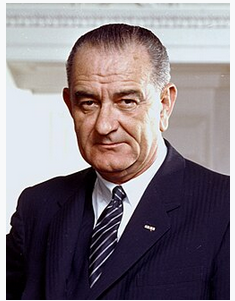
 November 22, 1963 - January 20, 1969 Lynden B. Johnson administration
Lenkowsky notes: “Lyndon B Johnson had neither a good knowledge of the Middle East nor a deeply motivated set of personal convictions or sympathies toward the area. He was first and foremost a skillful politician whose foreign policy attitudes were primarily dictated by the needs of his and his party's advancement in domestic politics as he perceived them.” The Arab view of U.S. fairness and impartiality changed radically during Lyndon B. Johnson's presidency.
Lenkowski p 105
Opinions vary. Other sources find in him a friend to Israel as early as 1939, when, as a congressman he begin raising money and pulling whatever strings were necessary to save as many Jews as he could from the Nazis. Over the next few years, hundreds of Jews were issued counterfeit passports and visas and brought to Johnson's home state of Texas, where they began new lives in the safety and security of America.
https://petahtikvah.com/Articles/LBJandISRAELbyJasonMaoz.htm
When JFK was killed, on November 22, 1963, Vice-President Lyndon B. Johnson (LBJ) became President. With the assumption of office by LBJ, the nature of the relationship between Israel and the U.S. underwent a rapid and dramatic change in favor of Israel.
In December 1996, author Daniel Neff wrote in the Washington Report on Middle East Affairs (WMREA): “Up to Johnson’s presidency, no administration had been as completely pro-Israel and anti-Arab as his.” Neff pointed out that although Truman had recognized Israel on account of Jewish support in his election, he “seemed to lose interest in the Jewish state.” Further, “Dwight D. was distinctly cool towards Israel, seeing it as a major irritant in America’s relations with the Arabs and America’s access to oil.” Although JFK was warmer towards Israel, “Yet he valued the U.S. position in the Arab world, particularly with Egypt’s Gamal Abdel Nasser, and as a result maintained a fairly even-handed policy despite having a number of pro-Israel officials in his administration.”
Stephen Green notes in his 1984 book Taking Sides: America’s Secret Relations with a Militant Israel “U.S. assistance to Israel in FY 1964, the last budget of the Kennedy administration, stood at $40 million. This was substantially reduced from the levels of assistance in previous years.” Green points out that in the FY 1965 this figure rose to $71 million and in FY 1966 to $130 million. Green adds: “More significant, however, was the change in the composition of that assistance. In FY 1964, virtually none of the official U.S. assistance for Israel was military assistance; it was split equally among the development loans and food assistance under PL 480 program. In FY 1965, however, 20 percent of U.S. aid was military in nature, and in FY 1966, fully 71 percent of all official assistance to Israel came in the form of credits for purchase of military equipment.” Not only did the major component of aid to Israel become military, the nature of weaponry supplied became dominantly attack or offensive in nature. As a result, the balance of power tilted entirely in Israel’s favor. JFK had broken the ban on supplying military equipment to Israel by supplying Israel with five batteries of Hawk missiles, but this was an air defense system. Once LBJ assumed power things changed drastically. Green writes: “The Johnson administration, in FY 1965-66, provided Israel with 250 modern (modified M-48) tanks, 48 A-1 Skyhawk attack aircraft, communications and electronic equipment, artillery and recoilless rifles. The $92 million in military assistance provided in FY 1966 was greater than the total of all military aid provided to Israel cumulatively, in all the years going back to the foundation of that nation in 1948.”
Therefore, the assassination of John Kennedy not only removed the barrier against Israel’s nuclear development, it also led to the provision of sophisticated offensive military equipment to an extent that Israel was in a position to launch an attack on the Arabs in 1967.
In his book on the Mossad role in JFK assassination, Michael Collins Piper quotes former U.S. Under Secretary of State George Ball: “First, the [Johnson] administration put America in the position of being Israel’s principal arms supplier and sole unqualified backer. Second, by assuring the Israelis that the United States would always provide them with a military edge over the Arabs, Johnson guaranteed the escalation of an arms race …. Third, by refusing to follow the advice of his aides that America make its delivery of nuclear-capable F-4 Phantoms conditional on Israel’s signing the Nuclear Non-Proliferation Treaty, Johnson gave the Israelis the impression that America had no fundamental objection to its nuclear program.”
Within two years of JFK’s assassination, Israel went from being a weak, outmatched member of a volatile Middle Eastern community that was not allowed to develop nuclear weapons to one that was well on its way to becoming an undeniable military force on the world stage.
Israel and the Bomb
While John Kennedy adamantly put his foot down and refused to allow Israel to develop a nuclear program, LBJ bent over backwards to facilitate and bolster them.” The attitude of Johnson with regard to Israel is astounding. In 2016, Roger J. Mattson’s book Stealing the Bomb: How Denial and Deception Armed Israel reveals that in the year 1968, then CIA Director Richard Helms reported to LBJ that Israel had developed nuclear weapons. How did LBJ respond? JFK researcher James DiEugenio notes that LBJ did not get upset, and did not order any investigation. Further, he told Helms to keep the news secret and specifically told the Director not to let the secretaries of State of Defense know about it.” Richard Helms was forced to bring the matter to the notice of the attorney general Ramsey Clark because a crime had been committed. But LBJ put a lid on the whole thing and the lid stayed there, allowing Israel to become a nuclear power.
https://en.dailypakistan.com.pk/04-Mar-2023/the-jfk-assassination-lyndon-b-johnson-and-israel
Since that time, in contrast to Washington's long-standing opposition to the spread of weapons of mass destruction, the United States has tacitly supported Israel's effort to maintain regional military superiority by turning a blind eye toward its various clandestine WMD programs, including its possession of upward of two hundred nuclear weapons.
(Mearsheimer and Walt p ???.)
The Six Day War
Israel wanted the green light from the United States to launch a war against Egypt and it's allies in 1967, but the Johnson White House was ambivalent. It took a memorandum from Angleton’s shop in the CIA arguing that Israel would quickly prevail over Egypt. When Richard Helms, the CIA director, expressed misgivings about passing it on to LBJ without some editing, Angleton dismissed the idea.
From the 2017 Biography of James J Angleton by Jefferson Morley,
The Ghost: The Secret Life of CIA Spymaster James Jesus Angleton
On June 5, 1967, following the US infusion of millions of dollars in weapons, and tensions between Israel and Egypt, the “Israeli Defense Forces,” IDF, launched a sudden attack on Egypt and her allies, including Jordan and Syria. On the eve of this invasion, Johnson secretly authorized an additional shipment to Israel of a variety of weapons and military equipment. The war was fought on land, sea, and in the air.
Lenkowski p 105-108
The IDF murdered hundreds of Egyptian prisoners of war, expelled between 100,000 and 260,000 Palestinians from the newly conquered West Bank, and drove 80,000 Syrians from the Golan Heights. When the victims of these ethnic cleansings tried to sneak back to their homes, often unarmed, Israelis sometimes shot them on sight. In six days, the Arab forces were almost entirely destroyed in Israel's "overwhelming victory".
(Mearsheimer and Walt p 99.)
1967 Attack on the USS Liberty On June 8, 1967, during the six day war, Israel attempted to sink the USS Liberty in international waters off the coast of Egypt. Johnson whitewashed the event. See the Liberty Icon.
After the “Six Day War” of June 1967, the United States emerged as the most distrusted if not actually hated country by all the Middle East.
Lenkowski p 105